If you're living in a multi-storey DDA flat or an independent house in Delhi NCR, climbing stairs every day isn't just tiring — for elderly family members or anyone with limited mobility, it can be genuinely difficult and even risky. A home lift solves this problem permanently, adding both convenience and long-term value to your property.
According to the Bureau of Labor Statistics, back and joint-related injuries account for a significant share of everyday physical strain, and repeated stair use is a common contributor for elderly residents and people recovering from surgery. A well-installed home lift removes that daily burden altogether.
As one of the trusted names among lift manufacturers in Delhi NCR, DNA Home Solutions has installed home lifts across DDA flats, builder floors, and independent houses throughout Delhi. Here's what actually goes into a professional home lift installation, and what you can expect at every stage.
Why More Delhi Homeowners Are Choosing Home Lifts
Home lifts aren't just a luxury anymore — they're becoming a practical necessity for many households in Delhi NCR. Some of the key benefits include:
- Safe, comfortable vertical movement for elderly family members and those with mobility issues
- Increased convenience for daily life — no more hauling groceries, luggage, or furniture up the stairs
- Higher resale value for your property
- A compact footprint that fits easily into most DDA flat layouts
- A far more manageable and space-efficient alternative to widening staircases or building ramps
Working with an experienced elevator company in Delhi ensures the entire process — from site evaluation to final handover — is handled safely and efficiently, typically over five key stages.
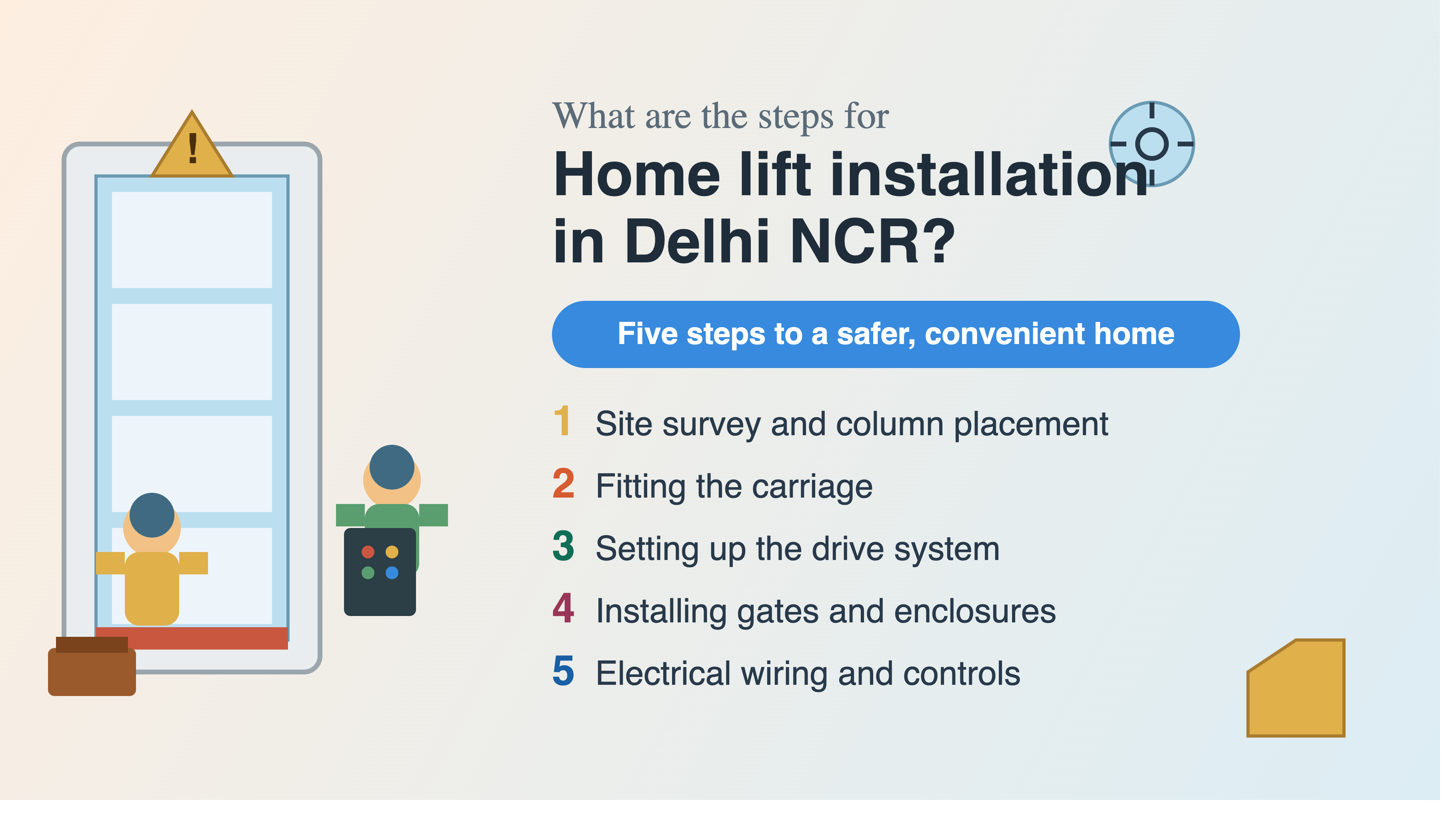
The 5 Steps of Home Lift Installation
1. Site Survey and Column Placement
Every home lift installation in a DDA flat starts with a detailed site visit. A technician from your chosen lift company in Delhi will assess:
- Available shaft or corner space, and whether it allows safe movement without disrupting your home's layout
- Floor strength at both levels, to confirm they can support the lift system once it's fully loaded
- Overhead clearance needed for smooth loading and unloading at each floor
Once the location is confirmed, the support columns and guide columns are anchored securely into place. This step matters a lot in DDA flats specifically, since space constraints often mean the installation has to be planned around existing structural elements rather than a purpose-built shaft.
2. Fitting the Carriage
Next, the team marks precise reference lines on the floor and walls to ensure the carriage — the cabin you'll actually ride in — travels evenly and level along the columns. The carriage is positioned exactly against these markings, wheel blocks are fitted and bolted to the carriage uprights, and the lift chains are connected. Everything is checked to confirm the chains stay properly seated on the sprocket as the carriage moves.
3. Setting Up the Drive System
For mechanical or hydraulic home lifts, this is where the drive unit is installed and secured above or alongside the columns, depending on the model. Once the motor and drive components are aligned correctly, they're bolted and, where needed, welded into place for long-term stability. This stage has a direct bearing on your overall lift installation cost, since drive mechanism and motor specifications vary based on load capacity and the number of floors served.
4. Installing Gates and Enclosures
Safety enclosures and gates are fitted to prevent accidental slips or falls while the lift is in motion. These are welded firmly into position and tested to make sure they lock properly at every floor stop — a non-negotiable step for any home with children or elderly residents.
5. Electrical Wiring and Controls
The final technical stage involves wiring all electrical components so the lift operates smoothly at the push of a button. A qualified technician tests the controls thoroughly to confirm the lift runs safely and can be operated easily by any family member.
Final Inspection and Handover
Before handover, a complete inspection is carried out to check every safety mechanism, weight limit, and moving part. Your family or a designated operator will then be walked through how to use the lift safely — completing the installation process.
What Determines Home Lift and Elevator Installation Cost?
One of the most common questions we get from homeowners across Delhi NCR is around cost of elevator installation in home settings. A few factors typically drive the final number:
- Number of floors and total travel height
- Load capacity required (passenger-only vs. passenger-plus-goods)
- Type of drive system — hydraulic, traction, or screw-and-nut
- Cabin finish and customization
- Site-specific structural work needed, especially in older DDA flats
Because every home is laid out differently, elevator installation cost can vary quite a bit between a compact DDA flat and a larger independent house — which is why a proper site survey should always come before any quote.
Choosing the Right Lift Partner in Delhi NCR
With so many lift suppliers in Delhi and elevator suppliers in Delhi competing for attention, it's worth choosing a company that handles the entire journey — survey, design, manufacturing, installation, and after-sales support — rather than outsourcing pieces of the job. As one of the established home lift manufacturers in Delhi, DNA Home Solutions specializes precisely in this kind of end-to-end residential lift installation, including projects in space-constrained DDA flats where standard shaft dimensions don't apply.
If you're considering a home lift and want to understand the actual cost to install a residential elevator in your specific home, get in touch with our team for a free site assessment. We'll walk you through design options, timelines, and a clear cost breakdown tailored to your property.
Ready to make your home more accessible? Contact DNA Home Solutions today for a personalized consultation on home lift installation in Delhi.