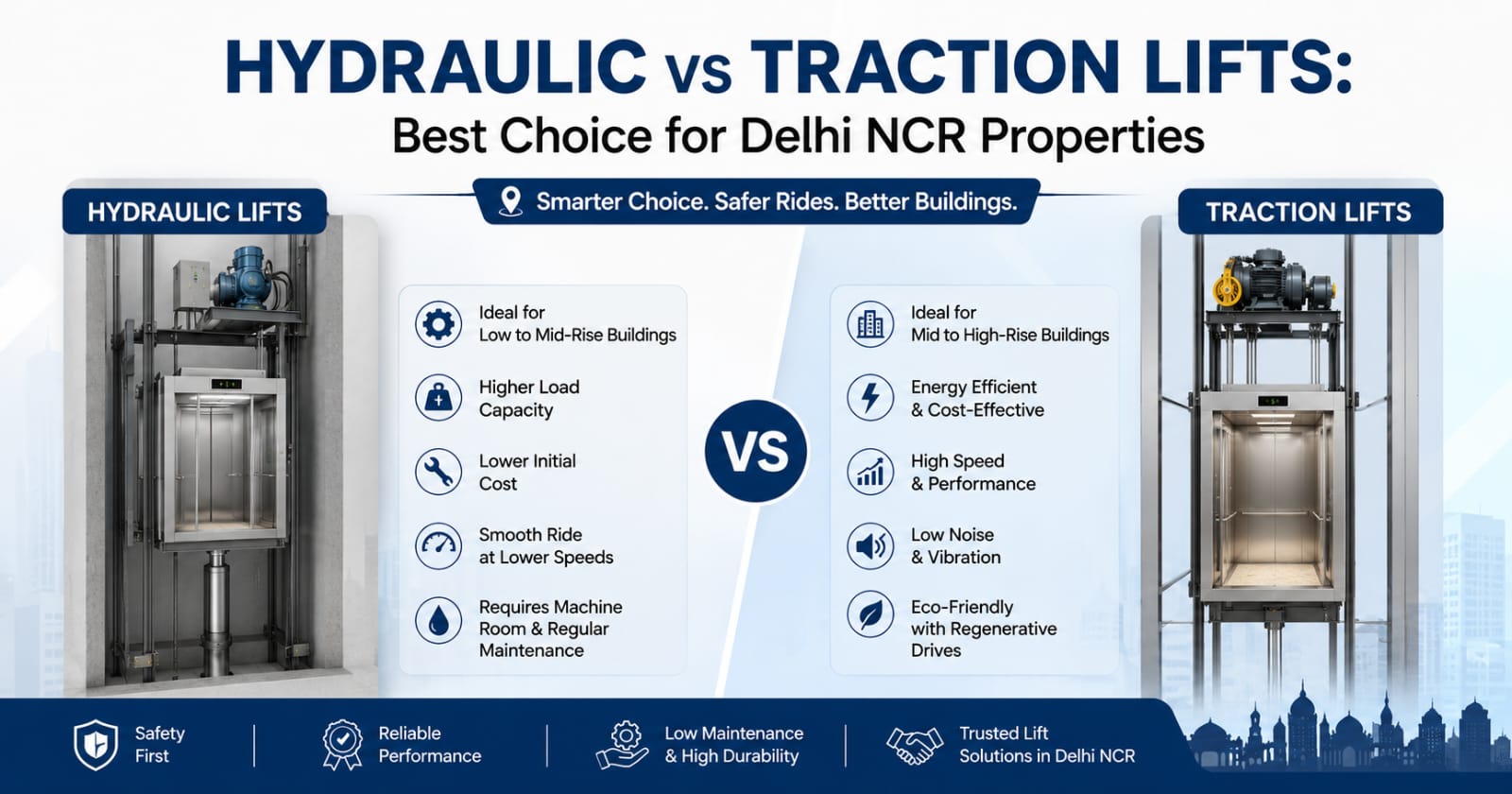
In fast-growing cities across Delhi NCR—including Delhi, Noida, Gurgaon, Ghaziabad, and Faridabad—land prices are soaring. This has driven a major shift toward vertical living, with property owners prioritizing multi-story buildings over expansive, horizontal layouts. Whether you own a luxury 4-story builder floor, a private independent villa, or a bustling commercial office, an elevator is no longer just a premium status symbol; it is a functional necessity for everyday mobility.
However, when you start exploring the market or speaking with a professional lift company in delhi, you will immediately encounter a major technical question: "Should you choose a Hydraulic Lift or a Traction Lift for your building?" Manufacturer brochures are frequently packed with dense engineering jargon that leaves the average buyer overwhelmed. Making the wrong choice can lead to high electricity bills, excessive monthly maintenance headaches, or wasted real estate inside your home.
This comprehensive guide breaks down the core differences between these two technologies in plain, clear language to help you choose the ideal system based on space, climate, and budget limitations in Delhi NCR.
1. Core Technology Explained: Hydraulic vs. Traction
Before diving into a direct comparison, it helps to understand how these mechanical systems operate in real-world setups.
- What is a Hydraulic Lift? Think of a hydraulic lift as a heavy-duty industrial jack, working on the exact same principle used to raise cars from the bottom at a service station. The system consists of an electric pump, a piston (cylinder), and specialized hydraulic oil. When the pump pushes oil into the cylinder, pressure builds up and drives the elevator cabin upward. When moving downward, the lift consumes zero power; it relies entirely on earth's gravity and the controlled, gradual return of the oil to its reservoir.
- What is a Traction Lift? This is the traditional, widely recognizable elevator technology seen in movies, residential high-rises, and major shopping malls. It operates similarly to pulling water out of a well using a rope and bucket system. It utilizes high-tensile steel cables (or ropes), a pulley wheel (sheave), and a counterweight (a heavy metal assembly that balances the cabin's weight). An electric motor drives the wheel, moving the elevator cabin up and down seamlessly.
2. Key Technical Differences
The architecture, space availability, and electrical infrastructure in Delhi NCR properties differ greatly from other regions. Here is how both technologies stack up across key performance metrics:
A) Space and Machine Room Requirements
- Hydraulic Lift: This system does not require a dedicated, structurally reinforced concrete machine room on top of your roof. The entire drive assembly fits into a compact control box that can be placed on the ground floor or basement near the shaft. Additionally, many modern hydraulic models do not require a deep foundation pit dug into the earth.
- Traction Lift: Traditional traction elevators mandatorily required a concrete machine room directly above the lift shaft. While modern MRL (Machine Room-Less) traction lifts house the motor directly inside the shaft walls, they still require fixed structural clearance at both the top (Overhead) and bottom (Pit) of the building.
B) Building Height and Floor Limitations
- Hydraulic Lift: This technology is explicitly engineered for low-to-medium-rise applications. It works best for buildings spanning 2 to 5 floors (approximately 15 to 20 meters in total travel height). Scaling a hydraulic cylinder beyond this height introduces extreme structural and logistical challenges.
- Traction Lift: When it comes to building height, traction systems are unmatched. Whether your property stands 4 stories tall or rises past 40 floors, traction elevators operate efficiently across any vertical distance.
C) Speed and Ride Comfort
- Hydraulic Lift: These systems move at a controlled, systematic pace (typically between 0.15 to 0.4 meters per second). However, they provide an incredibly quiet, vibration-free, and shock-independent ride quality. This gentle motion is exceptionally comfortable and reassuring for elderly family members or medical patients.
- Traction Lift: Traction systems are highly efficient and fast, operating at speeds of 1.0 meter per second or more. If your goal is to move a high volume of people quickly through a multi-story layout, traction is the clear path. Modern units equipped with Variable Voltage Variable Frequency (VVVF) drives also deliver an incredibly smooth ride.
D) Power Consumption and Electrical Load
- Hydraulic Lift: When moving upward, the electric motor draws significant current to pump the oil and push the full weight of the cabin. However, when traveling downward, it uses absolute zero electricity, shifting down smoothly via gravitational forces. Property owners must account for a higher initial power startup load when setting up the electrical configuration.
- Traction Lift: Thanks to the counterweight mechanism, the electric motor is never subjected to the cabin's full unassisted weight. As a result, it distributes power consumption uniformly during both upward and downward trips. For high-frequency commercial applications, a traction layout saves more energy over time compared to a hydraulic unit.
3. Real Estate Application: Matching the Lift to Your Property Type
The real estate footprint in the National Capital Region is diverse. The ideal lift choice depends entirely on your architectural layout and usage profile:
Property Type 1: Private Independent Villas, Kothis, and Duplexes (2 to 4 Floors)
If you are planning for a fresh lift installation in delhi inside an independent home for private family use, where the main goal is ensuring comfort for parents or adding premium value to your living space:
- Best Choice: Hydraulic Lift
- Why: Hydraulic systems are incredibly easy to retrofit into residential layouts. You bypass the need to construct an unsightly concrete machine room on your roof. If the house was not initially built with a lift shaft, it can easily fit into the open void of a central staircase or a corner room with minimal structural demolition.
Property Type 2: 4-Story Builder Floors (Stilt + 4 Parking Designs)
The Stilt + 4 parking residential model is the dominant architectural trend across South Delhi, Gurgaon, and Faridabad, where different floors are owned by independent families and share a common elevator.
- Best Choice: MRL (Machine Room-Less) Traction Lift
- Why: A shared builder floor elevator experiences heavy daily traffic from multiple families, children, domestic help, and delivery personnel. Under heavy, continuous operation, hydraulic oil can overheat, causing the system to temporarily trip for safety. A compact 4 to 6-passenger MRL traction lift is the most durable, dependable, and cost-effective option for shared residential infrastructure.
Property Type 3: Commercial Complexes, Corporate Offices, Hospitals, and Malls
If your property is a commercial workspace, a medical facility, or a retail center spanning more than 4 floors with continuous visitor movement:
- Best Choice: Gearless Traction Lift
- Why: Commercial real estate demands high transit speeds, continuous duty cycles, and sustained energy efficiency. A hydraulic system cannot cope with the demands of high foot traffic. Gearless traction lifts operate round-the-clock without overheating, providing fast, continuous transit.
4. Financial Investment, Maintenance, and Climate Considerations
The National Capital Region experiences an extreme climate, with temperatures soaring to 47°C in June and dropping sharply in January. Property owners must understand how local conditions affect these systems.
- The Weather Factor: Hydraulic systems rely on fluid dynamics. In extreme summer heat, the viscosity (thickness) of hydraulic oil can shift slightly, which may occasionally cause minor variations in floor-level alignment. Reputable engineering units and any leading lift manufacturer in delhi ncr counter this by installing integrated oil cooling units. Traction systems are purely mechanical and electrical, meaning local ambient temperatures have zero direct impact on their daily performance.
- Initial Capital vs. Long-Term Maintenance: Hydraulic lifts offer lower initial civil construction costs because you save money on heavy shafts and overhead roof rooms, though the machinery itself (especially from premium imported brands) carries a higher upfront cost. From a servicing perspective, a hydraulic system requires periodic oil top-ups and seal replacements after a few years. Conversely, a gearless traction lift requires very minimal ongoing maintenance, and replacement spare parts are readily available at highly competitive prices across local Delhi NCR markets.
5. Critical Safety Engineering: Earthquakes and Power Failures
Delhi NCR is positioned within Seismic Zone IV, making it highly vulnerable to earthquakes. Additionally, localized power cuts and voltage fluctuations are common occurrences during peak summer months.
- Hydraulic Performance During Power Outages: Hydraulic systems possess an inherent mechanical advantage during power failures. If the main power supply cuts out mid-travel, the lift does not require an expensive inverter array or heavy backup currents to lower passengers safely. The system's internal pressure valve opens automatically, letting gravity bring the cabin down smoothly to the closest or ground floor, where it releases the doors. The risk of getting trapped inside is virtually non-existent.
- Traction Performance During Power Outages: If a traction lift loses power, it locks in place between floors unless supported by external emergency systems. To ensure absolute safety, it is vital to integrate an ARD (Automatic Rescue Device) battery backup system. The ARD draws backup power to release the mechanical brakes, advance the cabin to the next available floor, and open the doors. Always ensure your vendor includes a premium ARD in your installation package.
Conclusion: Final Checklist for Property Owners
To eliminate any confusion and make an informed decision for your real estate investment, evaluate your project against these three targeted questions:
- What are the floor count and structural space limits? If your building stands between 2 to 4 stories tall and lacks the clearance for a deep concrete pit or an overhead machine room, a Hydraulic Lift is the ideal, non-intrusive choice.
- What is the primary usage profile? If the lift is dedicated strictly to a private family layout with low daily use, choose a Hydraulic Lift for maximum quietness and comfort. If the property is a shared builder floor or a commercial office welcoming dozens of daily visitors, an MRL Traction Lift is the standard for long-term reliability.
- What is your long-term maintenance approach? If you want to avoid structural disruptions during installation, go hydraulic. If you want a system where spare parts and maintenance services remain incredibly affordable at a local level for the next 15 to 20 years, investing in a Traction Lift is the safest path forward.
Selecting the right elevator system provides immense physical relief to elderly relatives while instantly raising the resale market value of your Delhi NCR property by up to 15% to 20%. Always ensure you commission a professional structural audit of your building before making an advance payment to a dealer.