Planning an elevator for your new residential villa or commercial building? Choosing the right lift size is not just a matter of luxury—it is a critical factor for architectural safety and space optimization.
If the lift size is smaller than required, tenants face annoying crowds and long waiting times. On the flip side, if the size is too large, you waste both precious building square footage and construction budget.
In this complete guide, we break down all the Passenger Lift Sizes 2026 Standards in simple, clear language. This is a completely brand-neutral, technically accurate guide designed to help you execute your project flawlessly.
3 Essential Terms for Understanding Lift Dimensions
Before diving into the exact dimensions of the lift chart, you need to understand these three foundational terms:
• Capacity (Weight Limit): The maximum weight (measured in kg) the elevator can safely lift. For calculation purposes, the average weight of a person is generally assumed to be between 65 kg to 70 kg.
• Cabin / Car Size: The actual interior space inside the elevator where passengers stand. This is always measured as Width × Depth (W × Depth).
• Shaft / Hoistway Size: The concrete or steel structural enclosure built within the walls where the elevator cabin travels up and down. The shaft size is always larger than the cabin size because it must accommodate the mechanical equipment, cables, and safety gears.
Complete Passenger Lift Size Chart 2026
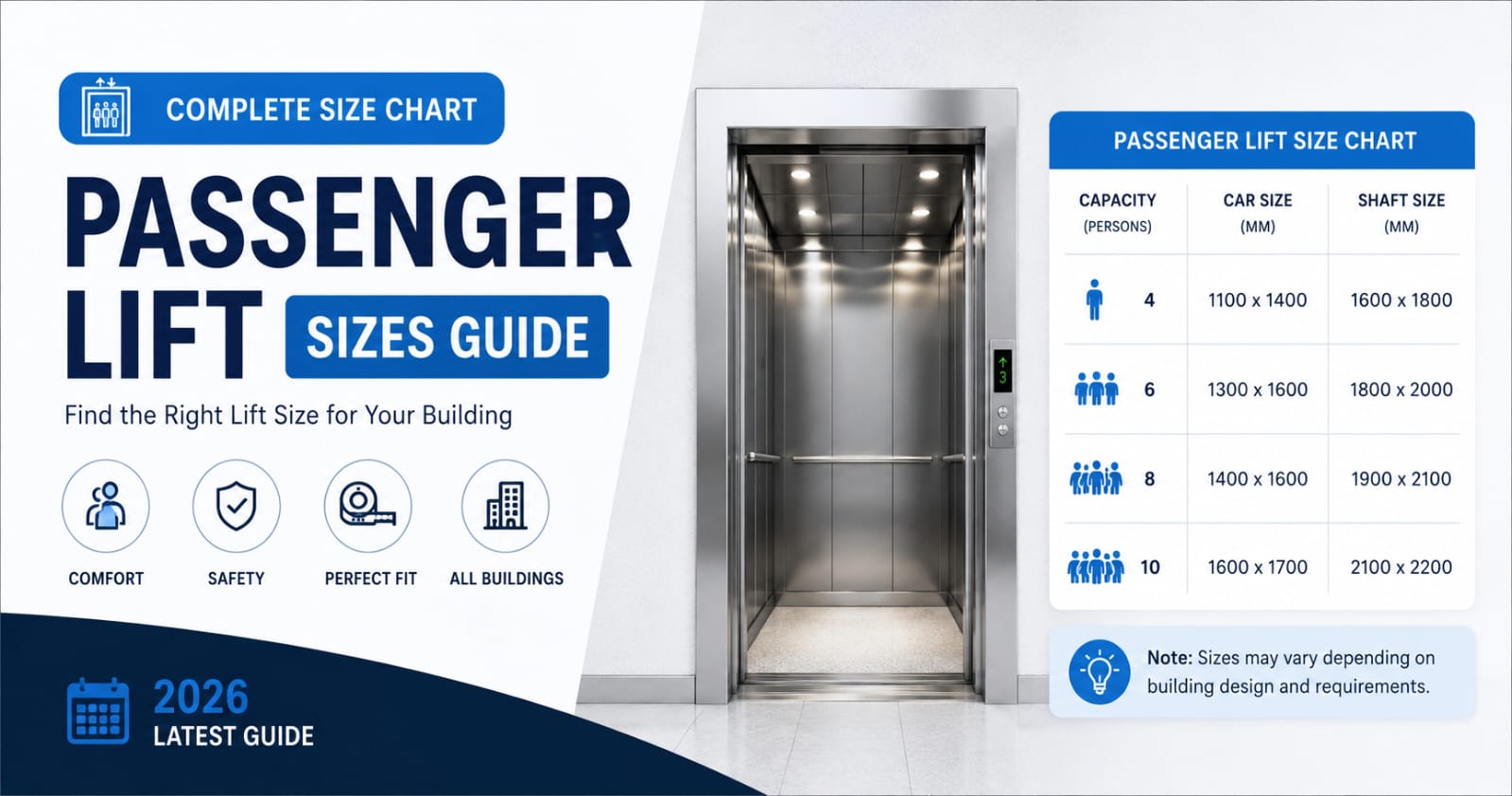
The following table provides the standard dimensions (measured in millimeters - mm) based on passenger capacity. These dimensions are optimized for modern automatic door systems:
| Passenger Capacity | Weight Capacity | Internal Cabin Size (W × D) mm | External Shaft Size (W × D) mm | Door Width mm |
|---|---|---|---|---|
| 4 Passengers | 320 kg | 900 mm × 1000 mm | 1300 mm × 1450 mm | 700 mm |
| 5 Passengers | 400 kg | 1100 mm × 1000 mm | 1500 mm × 1450 mm | 800 mm |
| 6 Passengers | 480 kg | 1100 mm × 1150 mm | 1500 mm × 1600 mm | 800 mm |
| 8 Passengers | 630 kg | 1100 mm × 1400 mm | 1600 mm × 1900 mm | 800 mm / 900 mm |
| 10 Passengers | 800 kg | 1350 mm × 1400 mm | 1800 mm × 1900 mm | 900 mm |
| 13 Passengers | 1000 kg | 1600 mm × 1400 mm | 2100 mm × 1900 mm | 1000 mm |
| 16 Passengers | 1250 kg | 2000 mm × 1400 mm | 2500 mm × 1900 mm | 1100 mm |
| 20 Passengers | 1600 kg | 2000 mm × 1700 mm | 2500 mm × 2200 mm | 1200 mm |
Choosing the Appropriate Lift According to Building Type
1. Exclusive Villas and Minimal Residential Buildings (Homes & Villas)
If you are searching for an elevator for a private 3 to 4-story house, a 4 to 6 passenger lift is the most appropriate option.
• The Advantage: These lifts have a very minimal footprint. However, if you have elderly family members or a wheelchair user at home, you should select at least a 5 or 6 passenger (400–440 kg) model. This ensures the door width is at least 800 mm, allowing a wheelchair to pass through easily.
2. Medium-Sized Offices and Commercial Properties (Mid-Rise Buildings & Offices)
For buildings spanning 4 to 10 stories or medium-sized corporate spaces, an 8 to 13 passenger (630 kg - 1000 kg) lift is highly recommended.
• The Advantage: This specific size easily manages heavy foot traffic during peak hours (such as morning arrivals and evening departures). It also allows passengers to comfortably carry luggage, briefcases, or small office supplies without crowding.
3. Shopping Centres, Large Hospitals, and High-Rise Buildings
In shopping malls, major commercial hubs, or residential societies with over 15 floors, a heavy-duty lift with a capacity of 16 to 20 passengers (1250 kg - 1600 kg) is the standard installation.
• The Advantage: Beyond managing massive crowd volumes, these elevators operate at high speeds (ranging from 1.5 m/s up to 4.0 m/s), drastically reducing travel time across tall vertical distances.
Vertical Dimensions: What Are Pit Depth and Ceiling Height?
Width and depth alone do not tell the full story. The vertical dimensions of your elevator shaft are equally vital for a functional installation:
• Pit Depth: This is the depth of the pit dug below the ground floor level of the lowest exposed floor. This space holds the lift buffers (structural shock absorbers) and lower safety gears. For modern 2026 gearless elevators, a standard pit depth of 1200 mm to 1500 mm is required (though it may be smaller for specific home lift models).
• Headroom (Overhead Height): This refers to the unrestricted, clear space above the ceiling of the topmost floor. To ensure the lift cabin aligns safely at the final landing and leaves enough room for machinery maintenance, a ceiling height clearance of 3800 mm to 4500 mm is required.
Wheelchair Accessibility (Universal Design Standards)
According to modern architectural guidelines in 2026, constructing disabled-friendly buildings is an absolute priority.
Thumb Rule: If you desire to make your building completely wheelchair-friendly, your internal cabin width must be at least 1100 mm and the depth must be 1400 mm (which equates to a minimum 8 passenger lift). Additionally, the door opening width should be between 800 mm to 900 mm to ensure smooth, unhindered wheelchair entry and exit.
Key Technical Factors to Discuss with Your Architect
When finalizing your elevator dimensions, ensure you collaborate closely with your project director or architect on these four technical points:
1. Machine Room vs. Machine-Room-Less (MRL): In prior days, a separate dedicated engine room had to be constructed directly above the lift shaft. In 2026, MRL (Machine-Room-Less) technology is the absolute industry standard. All the machinery is mounted directly inside the hoistway axle itself, saving valuable rooftop space.
2. Door Types: Automatic door routes come in two configurations: Center Opening (doors part from the middle to both sides) and Telescopic / Side Opening (doors slide completely to one side). If your layout has a narrow shaft width, telescopic doors are highly advantageous because they provide a large opening space within tighter structural widths.
3. Future Traffic Analysis: An elevator is a long-term infrastructure investment designed to last for the next 20 to 25 years. If a residential building houses 20 families today, you must account for future population growth and visitor traffic. Choosing one size larger than your current baseline is always a smart decision.
4. Safety Features: Be certain that the lift size you choose leaves enough space for an ARD (Automatic Rescue Device) unit. In case of a power failure, this safety system automatically brings the elevator car to the nearest floor and opens the doors safely.
Conclusion:
The structural size of a passenger lift serves as the true backbone of your building's vertical transport system. For residential homes, a compact 4–6 passenger lift effectively saves space, whereas commercial and public spaces rely on a standard 8–13 passenger layout. Always plan your space dimensions according to the data chart provided above before
beginning your civil sewer and layout construction work. This proactive planning protects your budget from expensive structural adjustments or re-working down the line.