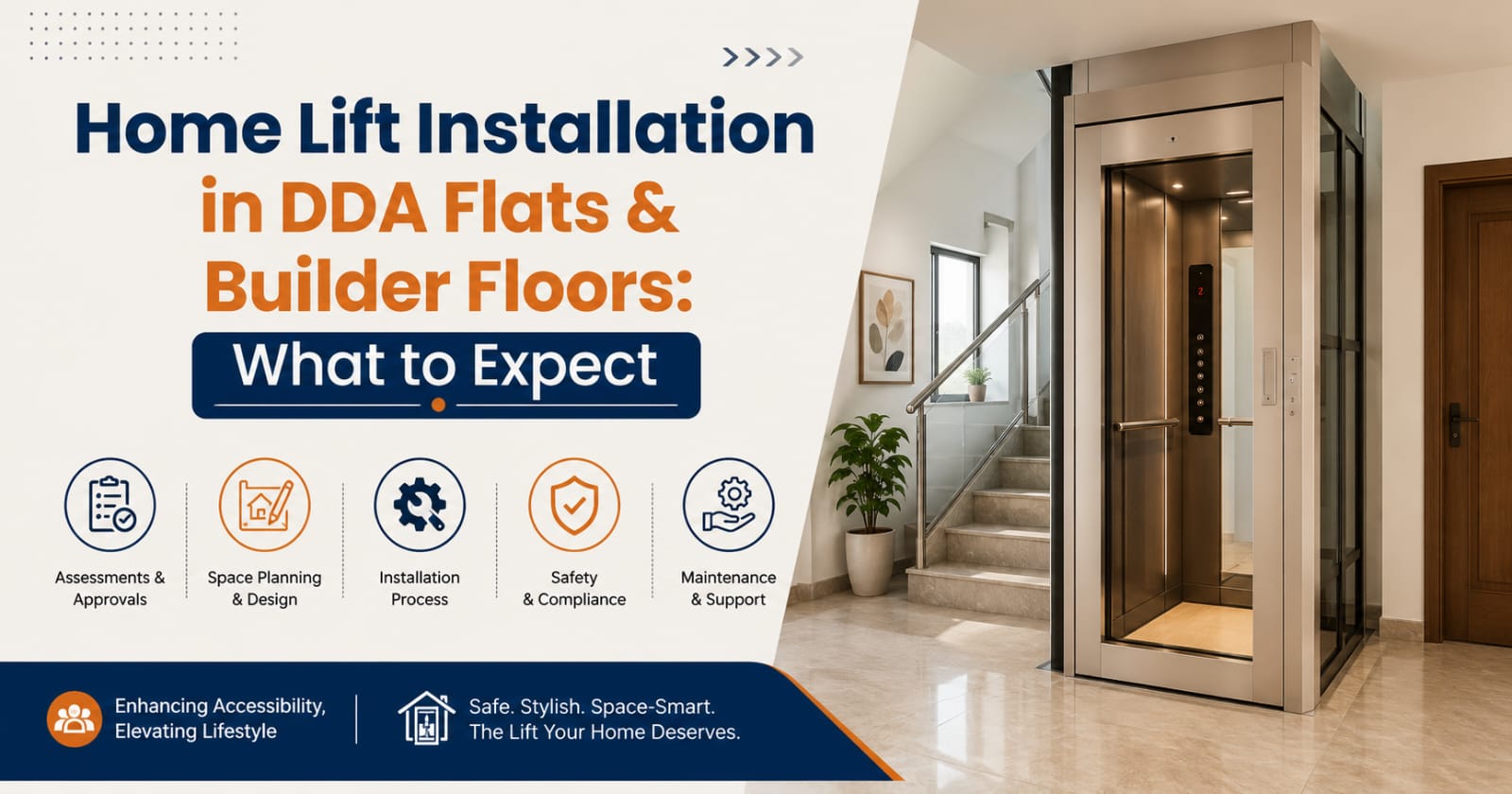
For residents living in the bustling multi-story residential pockets of Delhi and the National Capital Region (NCR), navigating stairs is a routine part of daily life. Whether you reside in Delhi Development Authority (DDA) apartments or independent builder floors, climbing up and down multiple flights of stairs is common.
However, as time passes, family members age, or knee and joint issues set in, these very stairs can transform from a daily workout into a painful structural barrier. In such scenarios, installing a residential home lift is no longer just a luxury—it becomes an absolute necessity for mobility and independence.
If you are planning to modify your property, this comprehensive guide will walk you through the structural variations, legal hurdles, cost estimates, and technical preparations you need to know before hiring a professional home lift installation in dda flats & builder floors.
1. Understanding the Architecture: DDA Flats vs. Builder Floors
The architectural layout of a property dictates how an elevator can be retrofitted. DDA flats and private builder floors have vastly different structural blueprints, which directly impacts your installation strategy.
DDA Development Authority (DDA) Flats:
Most older DDA complexes (such as SFS, MIG, or HIG flats) feature a Ground + 3 or Ground + 4 floor layout. These buildings rely on a common staircase or a central open courtyard (shaft area).
- The Challenge: Because these are community-centric blocks, you cannot alter the building layout without affecting other residents.
- The Solution: Retrofitting usually involves building an external steel-and-glass shaft in the common courtyard or adjacent to the shared staircase.
Independent Builder Floors
Modern builder floors are relatively lift-friendly. Many recent constructions come with a dedicated internal lift shaft left vacant by the builder.
- The Challenge: In older builder floors where the ground floor is reserved for stilt parking and the upper three to four floors are residential, space is tight.
- The Solution: Civil engineers must create a precise structural cut-out through the concrete slabs of each floor or utilize a balcony projection to install an external shaft.
2. Legal Regulations, Approvals, and Permissions in Delhi
You cannot simply purchase an elevator and install it overnight; residential modifications in the capital require strict adherence to local municipal bylaws.
- No Objection Certificate (NOC) from Neighbors: For DDA flats, obtaining written consent from all co-owners sharing your specific staircase block is mandatory. Ground and first-floor residents often worry about potential blockages to their natural light or ventilation. Open communication and choosing a transparent glass shaft design can help ease these neighborhood concerns.
- Technical Clearance from DDA/MCD: The authorities have eased norms to support senior citizens and medical cases. To secure an official sanction, you must hire a registered structural engineer to evaluate the building. They will issue a Structural Safety Certificate, proving that adding an elevator will not compromise the load-bearing capacity or foundational strength of the existing building.
- Compliance with the Delhi Lift Act: Every residential elevator setup must comply with the guidelines stipulated under the Delhi Lift Act and Rules. Once installation is complete, officials from the electrical department and the local lift inspectorate will perform a site inspection to grant an official operating license. Working with an experienced lift manufacturer in Delhi ensures your equipment automatically meets these statutory safety standards.
3. Types of Home Lifts: Which One Fits Your Property?
When consulting a professional lift service in Delhi, you will generally be presented with three core technologies. Your choice will depend on your budget, available footprint, and structural limitations.
A) Hydraulic Home Lifts
Hydraulic systems operate using a fluid-driven piston mechanism located beneath or alongside the elevator car.
- Pros: They do not require a massive overhead machine room on the roof. They run quietly and are highly customizable for compact residential spaces.
- Cons: They operate at a relatively moderate speed and require periodic hydraulic oil top-ups and seal replacements.
B) Machine Room-Less (MRL) Traction Lifts
These are downsized, residential versions of the traditional cable-driven elevators found in commercial malls, utilizing compact motors housed entirely within the shaft.
- Pros: Highly energy-efficient, fast, smooth, and built for heavy daily usage across multiple floors.
- Cons: They require a small pit at the bottom floor and a minimum amount of vertical clearance (headroom) at the topmost floor.
C) Vacuum or Pneumatic Lifts
A modern solution that utilizes air pressure differentials to move a cylindrical glass capsule up and down.
- Pros: Completely pit-less and headroom-free. They can be installed directly onto the finished floor, making them excellent for internal DDA flat renovations where deep digging is impossible.
- Cons: They carry a premium price tag and offer a limited weight carrying capacity, usually accommodating only 1 to 2 passengers at a time.
4. The Installation Timeline: Step-by-Step
A standard residential elevator project moves through four distinct execution phases:
- Site Survey & Civil Planning: Engineers measure the well-hole space, determine structural coordinates, and begin required demolition (like slab cutting or pit excavation).
- Erecting the Structural Shaft: If a concrete shaft does not exist, an external structural Mild Steel (MS) framework or a heavy-duty glass tower is anchored to the building.
- Mechanical Assembly: The expert team handling your lift installation in Delhi installs the guide rails, internal cabin, mechanical motor/pump, and handles the electrical control panel wiring.
- Safety Auditing & Testing: The elevator undergoes multiple days of rigorous weight-load testing, emergency brake checks, and trial runs before being handed over.
5. Cost Estimation and Budgeting Breakdown
The total cost of retrofitting an elevator depends on the number of stops, the selected drive mechanism, and the extent of civil work required.
Lift Technology Estimated Base Price (INR) Best Structural Suitability
MRL Traction Lift ₹8,00,000 – ₹12,00,000 New builder floors with pre-provisioned pit and headroom space.
Hydraulic Lift ₹10,00,000 – ₹15,00,000 External structural shafts for multi-floor DDA blocks.
Vacuum / Pneumatic Lift ₹12,00,000 – ₹20,00,000+ Internal duplex flats requiring zero structural break-up.
Budget Note: Always allocate an additional ₹2,00,000 to ₹4,00,000 for separate civil masonry, structural steel fabrication, municipal liaison fees, and power load upgrades.
1. Non-Negotiable Safety Features
Because a residential lift is primarily used by independent senior citizens, children, or individuals with mobility limitations, cutting corners on safety features is never an option. Ensure your provider includes:
Automatic Rescue Device (ARD): Power fluctuations and outages are common in Delhi. An ARD ensures that if the power cuts out, the elevator does not trap passengers between floors; it automatically draws backup battery power to glide to the nearest landing and open the doors.
Overload Sensor System: Prevents the elevator from moving if the weight limit is exceeded, triggering an audio-visual warning until the excess weight is removed.
Emergency Intercom & Alarm: A dedicated internal telephone line or siren button within the cabin to instantly connect with family members outside during an emergency.
Manual Lowering Valve: For hydraulic setups, this mechanical valve allows someone on the ground floor to manually bleed the pressure and lower the cabin safely in the event of a total system failure.
2. Practical Challenges and Maintenance
Before breaking ground on your project in dense urban neighborhoods like Dwarka, Rajouri Garden, or Saket, keep these operational elements in mind:
Electrical Infrastructure: Most standard home lifts require a stable three-phase electrical connection. You will likely need to apply to your local power discom (such as BSES or Tata Power DDL) to upgrade your home’s sanctioned electrical load.
Routine Maintenance: An elevator is a complex mechanical assembly that requires regular safety checks. When finalizing your contract, ensure you sign an annual maintenance contract (AMC) with an authorized lift company in Delhi to handle monthly lubrication, alignment checks, and emergency troubleshooting.
Conclusion:
Retrofitting a home lift into a DDA flat or an older builder floor is a highly rewarding structural investment. Beyond restoring complete freedom of movement to your elderly family members, it substantially increases the long-term resale market value of your property.
While navigating neighbor approvals and municipal paperwork requires patience, partnering with an established, licensed lift manufacturer in Delhi simplifies the entire execution pipeline. By prioritizing high-grade build components, structural safety clearance, and dependable after-sales care, you can ensure your home remains accessible, safe, and comfortable for generations to come.