In today's modern world, a lift is no longer just a luxury; it has become a functional necessity. Whether it is your dream luxury home or a multi-storey commercial complex, ensuring easy movement between floors is a top priority.
However, many people face a common dilemma: "Can I install a commercial lift in my home?" or "Will a small home lift be enough for my office?" If you are looking for these answers, this blog is for you. We have put technical jargon aside to help you understand the real differences in simple terms.
1. Introduction: The Fundamental Difference
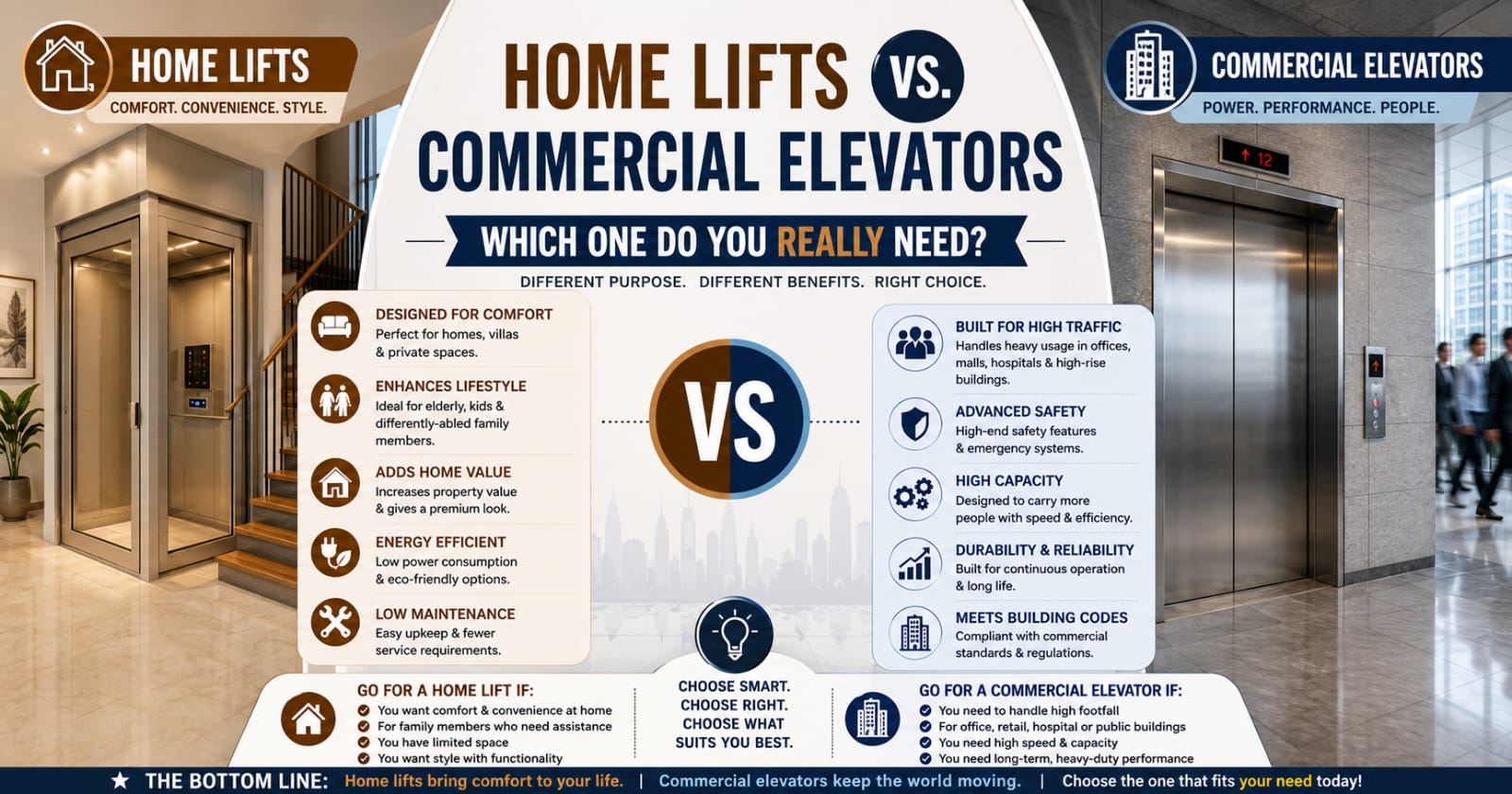
Before choosing, it is crucial to understand that not all lifts are engineered the same way. Their "DNA" is built for different environments:
- Home Lifts: Specifically designed for private residences (bungalows, villas). Their usage is low (perhaps 10–15 times a day), focusing primarily on comfort, quiet operation, and aesthetics.
- Commercial Elevators: These are heavy-duty machines built for high-traffic areas like malls, hospitals, and office buildings. They are designed to run every few minutes and carry hundreds of people throughout the day.
2. Weight Capacity: How Much Can They Carry?
Home Lifts
Since residential use involves only a few family members, home elevators typically have a capacity ranging from 200kg to 450kg. They can comfortably carry 2 to 5 people at a time.
Commercial Elevators
Commercial spaces experience heavy crowds. These lifts are built to handle 1,000kg to 2,000kg or more. In hospitals, stretcher elevators have even higher capacities to accommodate patients, heavy medical equipment, and staff simultaneously.
3. Speed and Operational Efficiency
Home Lifts
Speed is rarely a priority in a home setting. Home lifts are designed to move at a slow, steady pace to ensure a smooth and safe ride. Their speed usually ranges from 0.15 m/s to 0.4 m/s.
Commercial Elevators
In a 20-storey office building, a slow lift would lead to total chaos. Therefore, commercial elevators are much faster, ranging from 1.0 m/s to high-speeds of 3.0 m/s+ to ensure people reach their destinations quickly.
4. Space and Installation Requirements
Home Elevators (The Space Saviors)
Houses often lack the space for a massive concrete shaft. Modern home lifts, especially Machine Room-Less (MRL) or Pneumatic (Vacuum) Lifts, are incredibly compact. Some can even be installed without a "Pit" (the hole in the ground), making them easy to retrofit into existing homes.
Commercial Elevators (The Giants)
These require a dedicated concrete shaft, a deep pit, and often a separate "Machine Room" on the roof. Because their structure is heavy and complex, they must be planned during the initial construction phase of the building.
5. Maintenance and Power Consumption
- Home Lifts: Maintenance is affordable because the usage is minimal. Their power consumption is comparable to a standard Home AC or Refrigerator, and many models can run on a simple single-phase power supply.
- Commercial Elevators: These require a 3-phase heavy power supply. Maintenance must be frequent (usually monthly) because safety is a legal liability and heavy usage causes faster wear and tear. Consequently, the Annual Maintenance Contract (AMC) is more expensive.
6. Safety Regulations and Compliance
- Commercial Lifts: They must strictly follow the "Lift Act" and government safety standards. Regular inspections, fire safety certifications, and advanced emergency rescue systems are mandatory.
- Home Lifts: While they include essential safety features like Emergency Lowering Devices, the regulations are slightly more relaxed since they are located on private property.
7. Design and Aesthetics: Look and Feel
- Home Lifts: This is where you can get creative. You can opt for glass cabins, match the interior with your home furniture, and add designer lighting to enhance the "glory" of your residence.
- Commercial Lifts: The design is primarily functional and durable. They often use stainless steel finishes to resist scratches and ensure easy cleaning.
8. Final Verdict: At a Glance
|
Feature |
Home Lift |
Commercial Elevator |
|
Primary Use |
Private Houses / Villas |
Offices, Malls, Hospitals |
|
Capacity |
2 - 5 People |
8 - 20+ People |
|
Space Required |
Minimal (Compact) |
Large (Requires Pit/Shaft) |
|
Maintenance |
Low and Affordable |
High and Frequent |
|
Speed |
Slow and Smooth |
Fast |
Conclusion: How to Make the Right Choice?
If you live in a family bungalow and have elderly members or want to add a touch of luxury, a Home Lift is your best bet. Installing a commercial lift in a house would be a waste of money and space.
However, if you are running a boutique office or a clinic with constant foot traffic, never make the mistake of installing a home lift. It will not withstand the load and will break down frequently. In this case, a Commercial Elevator is a smart, long-term investment.
At DNA Home Solutions, we provide tailor-made solutions based on your building's specific needs. Whether it’s a space-saving home lift or a high-speed commercial elevator, we never compromise on safety and quality.
Which lift is right for your building? Consult our experts today and modernize your space!